Showing posts with label modern art. Show all posts

Tuesday, October 10, 2017

#InfiniteKusama means Millions of Dots!


Yayoi Kusama might be one of the most interesting artists I have ever encountered.  She is a Japanese artist in her 90's who is never seen without a glowing red or pink bob. In addition to being a painter and filmmaker, Kusama creates installation pieces with glowing pumpkins, millions of dots and mirrors that create a feeling of infinity (hence the trending hashtag #InfiniteKusama).

First and second grade artists looked at some of Kusama's art, then we created these pumpkin pieces inspired by her work. We started by choosing paper in warm and cool colors and comparing Kusama's dots the her angular background on some of her work.

After we wrapped up our pumpkins, students created collages inspired by Kusama's work. These free form collages explore her use of color and of course, dots!

A post shared by Nora (@artclass_allday) on


Tuesday, March 15, 2016

Op Art


What are the key characteristics of Op Art?
  • First and foremost, Op Art exists to fool the eye. Op compositions create a sort of visual tension, in the viewer's mind, that gives works the illusion of movement. For example, concentrate on Bridget Riley's Dominance Portfolio, Blue (1977) - for even a few seconds - and it begins to dance and wave in front of one's eyes. Realistically, you know any Op Art piece is flat, static and two-dimensional. Your eye, however, begins sending your brain the message that what it's seeing has begun to oscillate, flicker, throb and any other verb one can employ to mean: "Yikes! This painting is moving!"
  • Because of its geometrically-based nature, Op Art is, almost without exception, non-representational.
  • The elements employed (color, line and shape) are carefully chosen to achieve maximum effect.
  • The critical techniques used in Op Art are perspective and careful juxtaposition of color (whether chromatic [identifiable hues] or achromatic [black, white or gray]).
  • In Op Art, as in perhaps no other artistic school, positive and negative spaces in a composition are of equal importance. Op Art could not be created without both.
Read more at arthistory.about.com


Tuesday, October 8, 2013

Modern Art

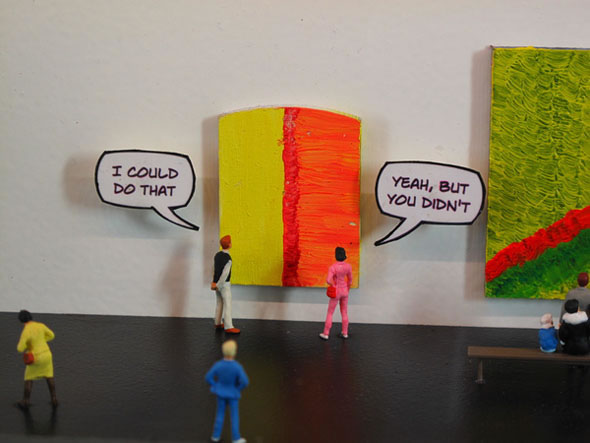
Have you seen the internet quiz "Can you tell the difference between Modern Art and Paintings by Toddlers?"  (Disclaimer: this site may contain other links that may not be appropriate for all ages)

As controversial as it may be to compare modern and contemporary art pieces to artwork by three-year-olds, I found this hilarious.  I also nailed it.  As an elementary art teacher and mom to a toddler, I guess I can really sniff out the "modern art" vs. the finger painting.  Whether you are a defender of modern art or really don't get it, see how you do on this quiz.

In the meantime... if these beautiful watercolor paintings made by our Kindergarten artists were billed as "Modern Art," I doubt anyone would question it.