This is the blog for the Waitsfield Elementary School Art Program in Waitsfield Vermont. This site is maintained by Nora McDonough. It contains photographs and information about past and current art projects completed at all levels, K-6.
Fifth and sixth grade artists used nothin' but paper to create some of the Seven Wonders of the World. We considered the Original Wonders, the Modern Wonders and the Seven Natural Wonders of the World. We looked at different ways for making paper into three-dimensional constructions.
The Global Cardboard Challenge is an annual event presented by the Imagination Foundation, which celebrates children’s creativity and the role that communities can play in fostering it. This event was inspired by the short film “Caine’s Arcade,” a story of a young boy’s cardboard creations. This project encourages kids to collaborate, innovate and think outside the box. Click here to learn more about the importance of creativity.
Here's a slideshow of our Waitsfield School Cardboard Challenge!
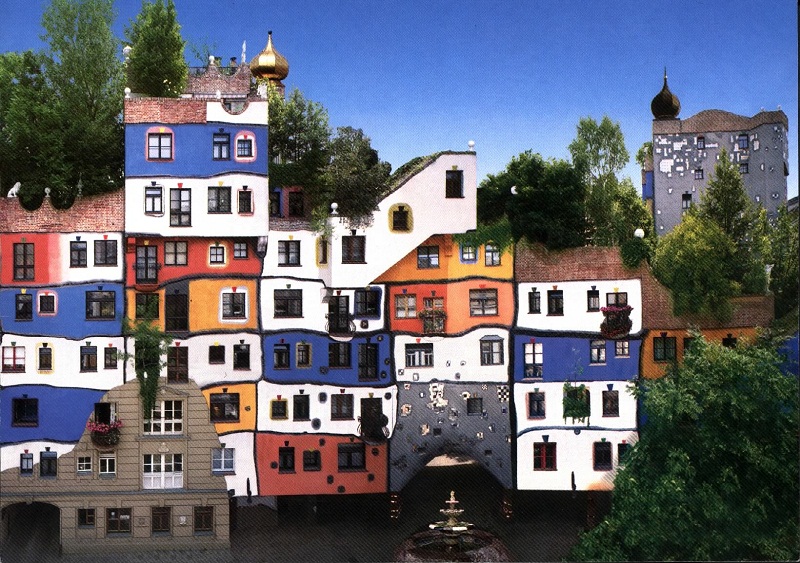
Friedensreich Hundertwasser (1928–2000) was an Austrian painter, architect, and sculptor best known for his architecture characterized by colorful, ornamental, and biomorphic shapes. He initially gained acclaim for his paintings, but later became more renowned for his unique architectural styling. In the 1950s, Hundertwasser began designing architectural projects. These designs use irregular forms, and incorporate natural features of the landscape. The Hundertwasserhaus apartment block in Vienna is one famous example. This building has undulating floors, a roof covered with earth and grass, and large trees growing from inside the rooms, with limbs extending from windows. He took no payment for the design of Hundertwasserhaus, declaring that the investment was worth it to "prevent something ugly from going up in its place".
Hundertwasser was against monotonous architecture, and called for a boycott of architecture with straight lines, and demanded instead creative freedom of building, and the right to create individual structures.
Fifth and sixth graders are using cardboard to make their architectural creations. We watched this video that describes unique ways that cardboard is used for construction.
Here are the mostly finished models to inspire our outdoor learning space. I love the creative use of natural materials and attention to the actual landscape and features of the site. These were completed by grades 3-6. Many thanks for Elizabeth for mixing up several batches of homemade green play-dough!
Today we continued our planning and model building for our Outdoor Learning Space. Artists worked with a variety of materials, including play-doh, modeling clay, felt, cardboard, wood and natural materials to build models in shallow boxes.
Some students, however, preferred to think outside the box.
(Any excuse to share a cartoon by my favorite cartoonist!)
We are working on creating models that will show the components of this outdoor learning space. Each group has chosen to focusing on a different area. Some groups are working on creating models that are to scale with the actual space.
Today we worked with Eleanor, Elizabeth and Kirsten to create sketches and models of some of the components of our outdoor learning space. Stay tuned to see more of these models.