Showing posts with label hands. Show all posts

Friday, September 21, 2018

Beautiful Hands

Kindergarten artists read "Beautiful hands by Kathryn Otoshi and Bret Baumgarten.  They traced their hands and colored them with construction paper crayons, then painted with liquid watercolors in warm or cool colors.  They observed the watercolor resist technique.

Friday, September 8, 2017

Waitsfield Students Reach for the Stars!


Welcome back, Waitsfield School!  
All students (even pre-K!) created a hand for our "Reach for the Stars" bulletin board. Students wrote their hopes and dreams for the school year on the stars.


Tuesday, December 6, 2016

Inspired by Picasso's "Bouquet of Peace"

Picasso's print is variously titled "Bouquet of Peace," "Hands with Flowers," "Hands with Bouquet," "Flowers and Hands," or any other variation on those words. Originally a watercolor drawing, Picasso subsequently printed the picture as a color lithograph.  He created it for a peace demonstration in Stockholm, Sweden in 1958.


"Bouquet of Peace" shows his desire for people to join together in love and harmony.  The brightly colored flowers convey a sense of hope and rebirth, and the bouquet forms a bond between two individuals symbolized by the two hands displayed within the piece.   The simplicity of the forms not only represents Picasso's desire for childlike innocence in his art, but also symbolizes the purity and openness needed to get along with others in peace. (Read more at http://artprep.weebly.com/picasso-bouquet-of-peace.html)

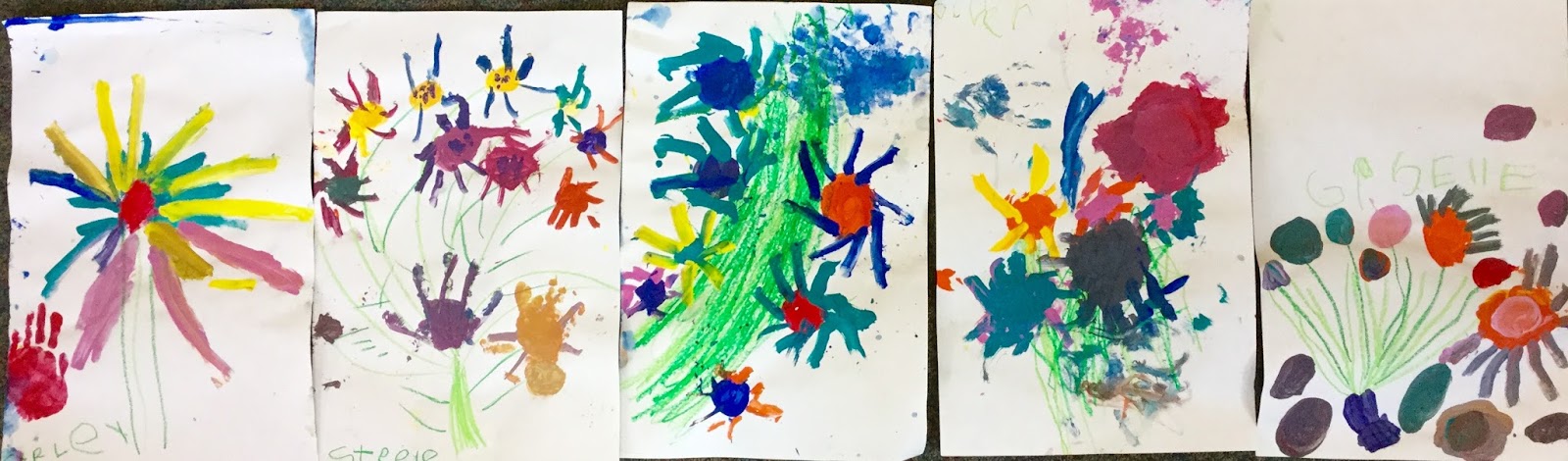
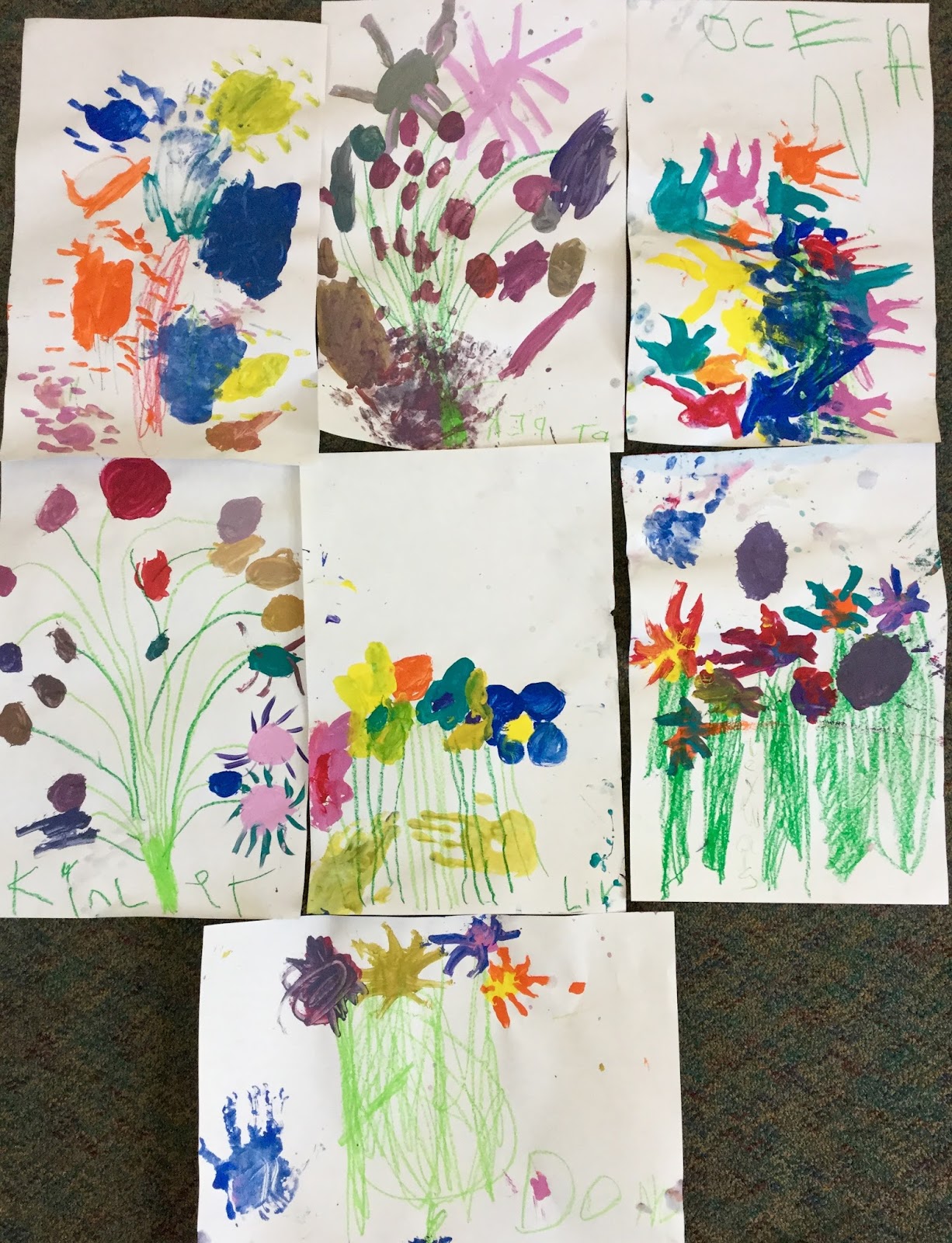
Kindergarten artists looked at Picasso's famous painting noticed that the two hands belong to different people.  This means that the flowers are being passed from one person to another. 

File_001.jpeg

 File_000.jpeg

Tuesday, March 15, 2016

Op Art


What are the key characteristics of Op Art?
  • First and foremost, Op Art exists to fool the eye. Op compositions create a sort of visual tension, in the viewer's mind, that gives works the illusion of movement. For example, concentrate on Bridget Riley's Dominance Portfolio, Blue (1977) - for even a few seconds - and it begins to dance and wave in front of one's eyes. Realistically, you know any Op Art piece is flat, static and two-dimensional. Your eye, however, begins sending your brain the message that what it's seeing has begun to oscillate, flicker, throb and any other verb one can employ to mean: "Yikes! This painting is moving!"
  • Because of its geometrically-based nature, Op Art is, almost without exception, non-representational.
  • The elements employed (color, line and shape) are carefully chosen to achieve maximum effect.
  • The critical techniques used in Op Art are perspective and careful juxtaposition of color (whether chromatic [identifiable hues] or achromatic [black, white or gray]).
  • In Op Art, as in perhaps no other artistic school, positive and negative spaces in a composition are of equal importance. Op Art could not be created without both.
Read more at arthistory.about.com


Tuesday, January 14, 2014

"With My Own Two Hands..."

Check out this video of Ben Harper singing "With My Own Two Hands."


What can you do with your own two hand to make our world a better place?  Each of us has the ability to make small differences that change our world.

First and second graders watched Ben Harper sing "With My Own Two Hands," then talked about ways that they can make a difference in their world.  They also learned to sing this song in music class and will be performing it at our school concert this week.